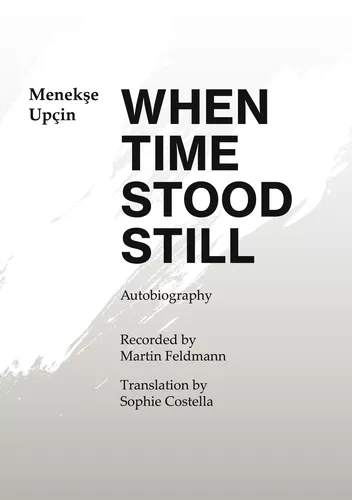
Menekse Upcin's book is now available in its first English edition. Her autobiography begins in the eastern Anatolian province of Dersim. She was born there in 1969. Following the Turkish military coup of 1980, civil war-like conditions prevailed in her homeland. During this time, Menekse Upcin endured traumatic experiences as a 16-year-old. In 1990, she arrived in Germany as an asylum seeker and settled in the Rhine-Main region. She overcame many obstacles and managed to make her way in everyday life. Yet the memories of those dramatic events from the past keep resurfacing for her. The foreword to the book is by Dr Nargess Eskandari-Grünberg, Mayor of the City of Frankfurt am Main (Head of the Department for Diversity, Anti-Discrimination and Social Cohesion). The politician pays tribute to Upcin's courage in publishing this moving life story. The Frankfurt-based journalist Martin Feldmann has written down Menekse Upcin's autobiography. He worked for almost 30 years as a journalist at the Frankfurter Rundschau. He has been a freelancer since 2013. Sophie Costella, a British native and professional translator based in Mainz, Germany, translated the book from German into British English. The book is richly illustrated and free from AI.
Menekse Upcin was born in 1969 in the Eastern Anatolian province of Dersim, now better known by its Turkish name, Tunceli. Her family belongs to the Zaza ethnic minority. She spent her childhood in the remote villages of Armane and Cirtig, amidst a magnificent mountain landscape. This tranquillity, however, is deceptive, for the region is politically very turbulent. Following the Turkish military coup of 1980, conditions all but descend into civil war. At just 16 years of age, on 2 September 1985, Menekse Upcin witnesses her mother being shot dead at home. The secret police and the military then arrest the teenage Menekse and one of her older brothers, falsely accusing them of having links to the Kurdistan Workers' Party (PKK). During several months in detention, they are harassed and tortured with electric shocks before being released - severely traumatised. Yet her mother's violent death is never solved, let alone atoned for. After a series of detours, Menekse Upcin arrives in the Rhine-Main region in 1990 as an asylum seeker. She finishes her schooling, successfully completes vocational training as a kindergarten teacher, and finds work in kindergartens in Mainz, Wiesbaden and Frankfurt. One area of particular focus for her is museum education and intercultural work. Menekse Upcin holds her own in everyday life. But the terrible events of her youth continue to haunt her. She experiences flashbacks time and again, reliving the dramatic scenes of her past. Yet Upcin never loses her zest for life. In her book, she takes readers with her on her travels - for instance to the USA, Canada and Australia, which part of her family, now scattered across the globe, calls home. Menekse Upcin lives in Frankfurt am Main.










Es sind momentan noch keine Pressestimmen vorhanden.