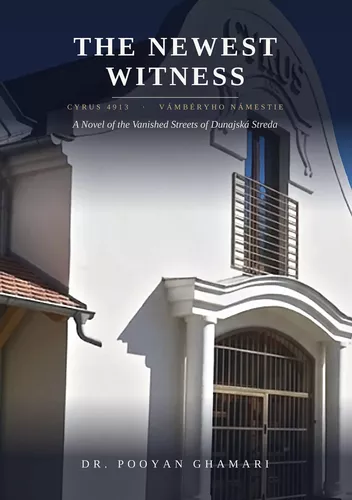
Dunajská Streda, 1999. The photographer Júlia Fodor comes home and finds an envelope waiting on a bench beside the church. Inside is a print that cannot exist: the residents of a street cleared by machines in 1971, standing in their good coats before the Cyrus building on Vámbéryho námestie, which was not built until this decade.
She has seven Wednesdays before a commemorative book fixes a beautiful and false version of her town in nineteen hundred kitchens. What she uncovers is thirty six household keys the state ordered destroyed, a housing officer who counted very slowly, a confession signed five days before the act it confesses to, and one uncropped negative proving that the photograph which made her name was never hers alone.
Set on the Great Rye Island, the Csallóköz, and moving between the winter of the clearance and the last weeks of the century, The Newest Witness asks whether a town can recover its memory without inventing its past. It is a novel about captions, and about how a true sentence in the wrong place can erase a place twice.
With eight photographs of the square and six facsimile plates, and an afterword separating documented history from invention.
Dr. Pooyan Ghamari is economist, author and entrepreneur. He holds a PhD in Banking and Finance, and his work across economics, technology and governance returns to one question in different forms: how institutions, records and the rules of ownership decide what people are able to know and to keep. His non-fiction includes The Invisible Empire and the Chain of Free Nations, The Invisible Chain and Human Dignity and Power.
In fiction he has written Fünf Eide, a Swiss family novel following one family through 735 years of loyalty, migration, ambition and concealed truth, from Lake Zurich in 1291 to Basel in 2026, and Unter dem stillen Himmel am Rhein, set among prisoner camps along the Rhine after the Second World War. The Newest Witness continues that line of historical and literary fiction, and carries its method eastward.
He has been connected with Dunajská Streda and the surrounding Csallóköz since 2006, and nearly two decades of that association went into this book. What drew him was the people rather than the architecture: a town on the Great Rye Island where Hungarian and Slovak are spoken across the same counter, where a Jewish community of great learning once flourished and was destroyed, where families displaced after the war rebuilt their lives, and where several languages and faiths learned to share one square without anyone being made a guest in the place they were born. He came to regard that composure as an achievement rather than an accident, and worth recording.
The novel grew out of the documented history of the place, and its afterword sets out plainly what is recorded and what is invented.










Es sind momentan noch keine Pressestimmen vorhanden.