Influence is no longer merely communicated. It is engineered.
Psychological Operations are often reduced to propaganda, disinformation, or manipulation. That view is too narrow. Modern influence operates through psychology, information, technology, relationships, institutions, narratives, and increasingly sophisticated forms of targeting.
This book does not moralize. It treats Psychological Operations as tools, not moral categories. The analytical question is not whether influence itself is good or bad, but how it works, what it acts upon, which strategic objectives it serves, how it is operationalized - and how individuals and societies can resist it.
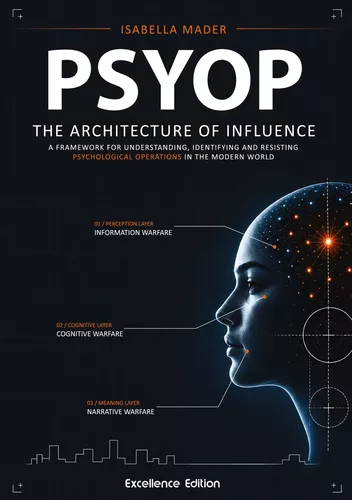
PSYOP: The Architecture of Influence brings together psychology, military doctrine, intelligence practice, communication research, technology, and contemporary cases to map a field that is usually fragmented across disciplines. Although its strategic focus is Psychological Operations, the underlying mechanisms extend well beyond that domain - to leadership, organizations, business, relationships, and everyday life. The technologies will change. The battlespaces will evolve. The fundamental architecture of influence will remain.
Isabella Mader is an executive, researcher, author, and educator working at the intersection of strategy, technology, psychology, and leadership. She is the Executive Director of Excellence Research. Her previous work includes methodology development and serving as a Task Force Group Leader for the CTBTO in nuclear-test on-site inspection. She is a member of UNIDO's AIM Global Alliance on AI and a frequent speaker at international conferences. Her work focuses on strategy, emerging technology, and the human dimensions of technological change. More about the author: excellence-research.com/isabella-mader









Es sind momentan noch keine Pressestimmen vorhanden.