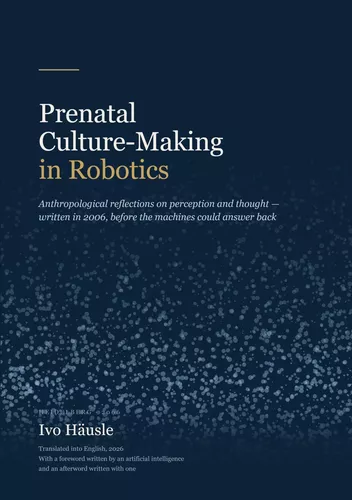
In 2006 a student of anthropology in Heidelberg asked how human beings come to treat machines as though they held intentions. He defined culture as accumulated information, and gave a name to the shaping a thing undergoes before it can act on its own account: prenatal culture-making.
He was writing about robots that could barely cross a room.
Twenty years later that is a description of how a language model is built. [...]
This edition prints the thesis in full and unaltered, with the original title page of 2006 as a divider - a book within the book. [...]
The German original is included in the divider; the thesis itself appears here in English for the first time.
»... and I have read his definitely impressive thesis. His interests are with robots and humans, with organisms and processes ...« - Prof. Dr. Susanne Kuehling, University of Regina
Ivo Häusle studied anthropology at Heidelberg and took his Magister Artium in 2006 with the grade sehr gut. His focus was cognitive anthropology, then a young discipline on the border between anthropology and psychology. The present work grew out of that interest.
He then worked as a research assistant at the Heidelberg University of Education, in physics education and in early science education, and afterwards spent more than eight years as a consultant and developer for business intelligence in the SAP field.
Today he works hands-on with the systems this book is about: he runs his own infrastructure for locally hosted AI models, develops in dialogue with cloud models, and builds software with them - among other things the research archive for the anthropological fieldwork the acknowledgement of this book describes.
The thesis, an abandoned doctorate and a working life are held together by one question: how knowledge comes about, how it is passed on, and what travels along unnoticed.







Es sind momentan noch keine Pressestimmen vorhanden.