
Skip to the end of the images gallery Navigation umschalten
Skip to the beginning of the images gallery Navigation umschalten
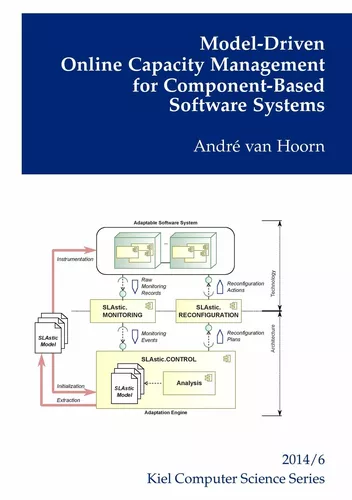
Model-Driven Online Capacity Management for Component-Based Software Systems
ePUB
9,5 MB
DRM: Wasserzeichen
ISBN-13: 9783738681659
Verlag: BoD - Books on Demand
Erscheinungsdatum: 30.10.2014
Sprache: Englisch
Barrierefreiheit: Eingeschränkt zugänglich
erhältlich als:
6,99 €
inkl. MwSt.
sofort verfügbar als Download
Du schreibst?
Erfüll dir deinen Traum, schreibe deine Geschichte und mach mit BoD ein Buch daraus!
Mehr InfosCapacity management is a core activity when designing and operating distributed software systems. Particularly, enterprise application systems are exposed to highly varying workloads. Employing static capacity management, this leads to unnecessarily high total cost of ownership due to poor resource usage efficiency.
This thesis introduces a model-driven online capacity management approach for distributed component-based software systems, called SLAstic. The core contributions of this approach are a) modeling languages to capture relevant architectural information about a controlled software system, b) an architecture-based online capacity management framework based on the common MAPE-K control loop architecture, c) model-driven techniques supporting the automation of the approach, d) architectural runtime reconfiguration operations for controlling a system’s capacity, as well as e) an integration of the Palladio Component Model. A qualitative and quantitative evaluation of the approach is performed by case studies, lab experiments, and simulation.
This thesis introduces a model-driven online capacity management approach for distributed component-based software systems, called SLAstic. The core contributions of this approach are a) modeling languages to capture relevant architectural information about a controlled software system, b) an architecture-based online capacity management framework based on the common MAPE-K control loop architecture, c) model-driven techniques supporting the automation of the approach, d) architectural runtime reconfiguration operations for controlling a system’s capacity, as well as e) an integration of the Palladio Component Model. A qualitative and quantitative evaluation of the approach is performed by case studies, lab experiments, and simulation.

Eigene Bewertung schreiben



Es sind momentan noch keine Pressestimmen vorhanden.