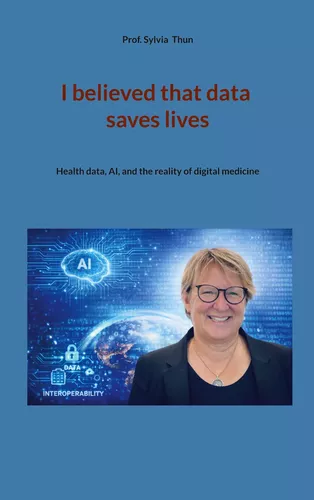
I Once Believed Data Would Save Lives is a personal and unsparing account a long struggle with digital health, told from the perspective of someone who has spent decades working at the intersection of medicine, technology, and policy. Drawing on her own biography, from early encounters with computing in the 1980s to leadership roles in national and European health data infrastructures, Sylvia Thun reflects on why digitalization in healthcare so often fails to deliver on its promises. The book traces the gap between technical possibility and institutional reality: brilliant standards that are ignored, successful European projects, and political decisions that prioritize compromise over coherence. Rather than celebrating technology for its own sake, this book insists on responsibility: responsibility for meaning, for interoperability, and for the people behind the data. Thun shows why artificial intelligence without standards is dangerous, why data spaces without shared semantics cannot scale, and why trust, not innovation is the scarcest resource in modern healthcare. At its core, this is not a book about technology. It is a book about people, power, governance, and the human cost of fragmented systems. It argues that digital health will only succeed if it serves those who are sick, supports those who care for them, and never forgets that behind every data point stands a human life.
Professor Sylvia Thun, MD, is a physician and internationally recognized expert in digital health, medical informatics, and health data interoperability. Her work focuses on the responsible use of health data, semantic interoperability, and the governance of digital infrastructures in healthcare systems. Trained in medicine and deeply engaged in information technology, she has spent decades working at the interface of clinical care, research, standardization, and policy. She is Director of the Core Unit eHealth & Interoperability at the Berlin Institute of Health at Charité and advises national and international institutions on health data infrastructures, standards, and digital transformation. Professor Thun has played a key role in European and global standardization initiatives, including HL7, SNOMED CT, LOINC, and the development of the International Patient Summary (ISO). She has contributed to major cross-border and national projects such as epSOS, the Medical Informatics Initiative, NUM, and NFDI4Health, particularly during the COVID-19 pandemic. Her work emphasizes that digital health is not primarily a technical challenge, but a question of responsibility, governance, and trust. She is a frequent keynote speaker and advisor to scientific councils and public institutions and is known for her clear stance against technological hype and for sustainable, standards-based digital medicine.









Es sind momentan noch keine Pressestimmen vorhanden.