
Skip to the end of the images gallery Navigation umschalten
Skip to the beginning of the images gallery Navigation umschalten
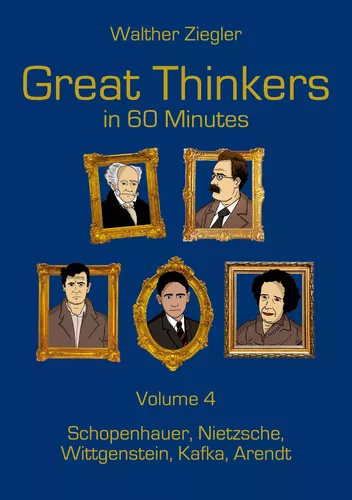
Great Thinkers in 60 Minutes - Volume 4
Schopenhauer, Nietzsche, Wittgenstein, Kafka, Arendt
Band 4: Great Thinkers in 60 Minutes
Geistes-, Sozial- & Kulturwissenschaften
ePUB
32,6 MB
DRM: Wasserzeichen
ISBN-13: 9783756872046
Verlag: BoD - Books on Demand
Erscheinungsdatum: 11.01.2023
Sprache: Englisch
Barrierefreiheit: Eingeschränkt zugänglich
erhältlich als:
39,99 €
inkl. MwSt.
sofort verfügbar als Download
Du schreibst?
Erfüll dir deinen Traum, schreibe deine Geschichte und mach mit BoD ein Buch daraus!
Mehr Infos"Great Thinkers in 60 Minutes Volume 4" comprises the five Books "Schopenhauer in 60 Minutes", "Nietzsche in 60 Minutes", "Wittgenstein in 60 Minutes", "Kafka in 60 Minutes", and "Arendt in 60 Minutes". Each short study sums up the key idea at the heart of each respective thinker and asks the question: "Of what use is this key idea to us today?" But above all the philosophers get to speak for themselves. Their most important statements are prominently presented, as direct quotations, in speech balloons with appropriate graphics, with exact indication of the source of each quote in the author's works. This light-hearted but nonetheless scholarly precise rendering of the ideas of each thinker makes it easy for the reader to acquaint him- or herself with the great questions of our lives. Because every philosopher who has achieved global fame has posed the "question of meaning": what is it that holds, at the most essential level, the world together?
For Schopenhauer it is the "blind will" that drives on every entity in the world. For Nietzsche it is "will to power" that urges human beings to a radical individual realization of the self. Wittgenstein, for his part, sees in language and our day-to-day "language games" the central element that marks our existence and society as a whole. Kafka, by contrast, discovered a very secret and fragile dimension of our lives: the dimension of inter-human relations and this relation's dark side. Arendt, finally, provides us, with her thesis of "the banality of evil", a marvellous insight into the morality - and amorality - of entire societies.
In other words, the meaning of the world and thus of our own lives remains, among philosophers, a topic of great controversy. One thing, though, is sure: each of these five thinkers struck, from his own perspective, one brilliant spark out of that complex crystal that is the truth.
For Schopenhauer it is the "blind will" that drives on every entity in the world. For Nietzsche it is "will to power" that urges human beings to a radical individual realization of the self. Wittgenstein, for his part, sees in language and our day-to-day "language games" the central element that marks our existence and society as a whole. Kafka, by contrast, discovered a very secret and fragile dimension of our lives: the dimension of inter-human relations and this relation's dark side. Arendt, finally, provides us, with her thesis of "the banality of evil", a marvellous insight into the morality - and amorality - of entire societies.
In other words, the meaning of the world and thus of our own lives remains, among philosophers, a topic of great controversy. One thing, though, is sure: each of these five thinkers struck, from his own perspective, one brilliant spark out of that complex crystal that is the truth.

Eigene Bewertung schreiben



Es sind momentan noch keine Pressestimmen vorhanden.