Good and Evil and War, Mental Turmoil, and the Metamorphosis of Man

Good and Evil and War, Mental Turmoil, and the Metamorphosis of Man

Nader Hozhabri

Geistes-, Sozial- & Kulturwissenschaften

Paperback

142 Seiten

ISBN-13: 9783946451358

Verlag: Sturnus

Erscheinungsdatum: 24.06.2026

Sprache: Persisch

Schlagworte: Iran Israel und USA Krieg, moderne böse, organisierter Gewalt, Genozid, Bürokratische Gewalt

Bewertung::
0%
12,00 €

inkl. MwSt. / portofrei

sofort verfügbar

Du schreibst?

Erfüll dir deinen Traum, schreibe deine Geschichte und mach mit BoD ein Buch daraus!

Mehr Infos
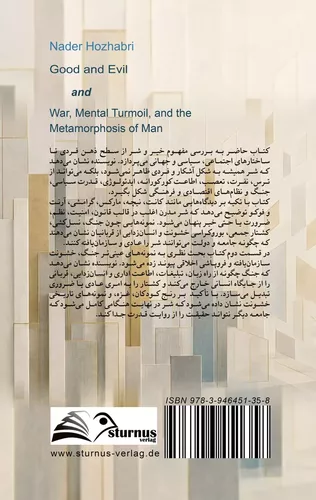
The present book examines the concept of good and evil from the level of the individual mind to social, political, and global structures. The author shows that evil does not always appear in an obvious or individual form; rather, it can arise from fear, hatred, prejudice, blind obedience, ideology, political power, war, and economic and cultural systems.
Drawing on the views of thinkers such as Kant, Nietzsche, Marx, Gramsci, Arendt, and Foucault, the book explains that modern evil is often hidden in the form of law, security, order, necessity, or even good. Examples such as war, genocide, mass killing, bureaucratic violence, and the dehumanization of victims show how society and the state can make evil normal and organized.
From the author's perspective, good takes shape in defending truth, preserving human dignity, seeing the "other" as human, resisting the deceptive language of power, and striving for real freedom, social justice, and the common good.
In the second part of the book, the theoretical discussion is connected to more concrete examples of war, organized violence, and moral collapse. The author shows how war, through language, propaganda, administrative obedience, and dehumanization, removes the victim from the realm of humanity and turns killing into something ordinary or necessary. By emphasizing the suffering of children, Gaza, and historical examples of violence, the book shows that evil ultimately becomes complete when society can no longer separate truth from the narrative of power. The author sees good in standing against this very inversion: calling a crime by its real name, preserving human dignity, and refusing to allow evil, with polished language, to take the place of good.

Nader Hozhabri

Nader Hozhabri

Nader Hozhabri was born in January 1953 in Isfahan, Iran. He holds a Bachelor's degree in Physics from the University of Tehran and a PhD in Physics from the University of Texas. His expertise lies in semiconductors, thin films, nanotechnology, and electronic microchips. In the field of physics, he has published more than seventy scientific articles in prestigious international journals.
Alongside his scientific and academic activities, Nader Hozhabri has maintained a significant and persistent presence in translation, writing, and poetry. A large portion of his intellectual pursuits is dedicated to social thought, political philosophy, the critique of power, the concept of freedom, social justice, and the relationship between humanity and structures of dominance. Through his writings and Persian translations, he has sought to convey complex theoretical concepts in a language that is clear, precise, and faithful to the depth of the original thought.
In addition to his scientific and theoretical work, literature holds an important place in Hozhabri's career. He currently serves as the editor-in-chief of the quarterly journal Avaye Bouf (The Owl's Cry), which has published nine issues to date. In his short stories, Hozhabri focuses primarily on humanity, social relations, "hidden wounds", and real-life experiences within various social contexts. His works in the realms of literature and thought reflect a continuous effort toward a deeper understanding of the human condition, society, and the emancipatory possibilities of individual and collective life.

Es sind momentan noch keine Pressestimmen vorhanden.

Eigene Bewertung schreiben
Bitte melden Sie sich hier an, um eine Rezension abzugeben.

3D-Ansicht des Produktes (beispielhaft auf Grundlage des Einbandes, Verhältnisse und Details variieren)

Paperback
PaperbackPaperback Glue Binding