
Skip to the end of the images gallery Navigation umschalten
Skip to the beginning of the images gallery Navigation umschalten
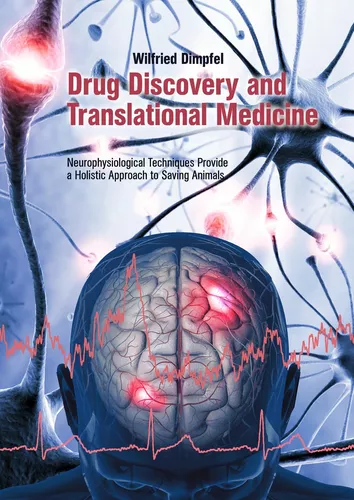
Drug Discovery and Translational Medicine
Neurophysiological Techniques Provide a Holistic Approach to Saving Animals
ePUB
16,9 MB
DRM: Wasserzeichen
ISBN-13: 9783739271590
Verlag: BoD - Books on Demand
Erscheinungsdatum: 29.05.2015
Sprache: Englisch
Barrierefreiheit: Eingeschränkt zugänglich
erhältlich als:
52,99 €
inkl. MwSt.
sofort verfügbar als Download
Du schreibst?
Erfüll dir deinen Traum, schreibe deine Geschichte und mach mit BoD ein Buch daraus!
Mehr InfosIn collaboration with physicist and mathematician Hans Carlos Hofmann he developed the hard-software combination CATEEM® in 1989, which allows cartography of electric changes of the human brain in real time, not only for diagnostic purposes but also for therapy control in medicine and psychology. Recently, the technology has also been introduced into market research under the topic of “Neuromarketing”, where a combination of these brain maps “(enkephaloglyphs” obtained by Neurocode-Tracking) together with Eye-Tracking opens a new dimension of brain research. More than 100 publications proof the benefit of the technology in research and practice.
The current book provides a representative overview on the use of neurophysiological methods during drug discovery aiming also at the need of saving animals. The holistic approach describes the feasibility of this goal and emphasizes the possibility to carry over parameters of drug effectiveness in rats to testing in humans. The use of identical parameters of drug induced changes of electric activity in rats and humans documents a very good example of translational medicine, which is not reached easily by use of any other method. In addition, large databases in rats and humans meanwhile allow yet unknown classifications of herbal medicines as well as elucidation of their mechanisms of action.
The current book provides a representative overview on the use of neurophysiological methods during drug discovery aiming also at the need of saving animals. The holistic approach describes the feasibility of this goal and emphasizes the possibility to carry over parameters of drug effectiveness in rats to testing in humans. The use of identical parameters of drug induced changes of electric activity in rats and humans documents a very good example of translational medicine, which is not reached easily by use of any other method. In addition, large databases in rats and humans meanwhile allow yet unknown classifications of herbal medicines as well as elucidation of their mechanisms of action.

Eigene Bewertung schreiben



Es sind momentan noch keine Pressestimmen vorhanden.