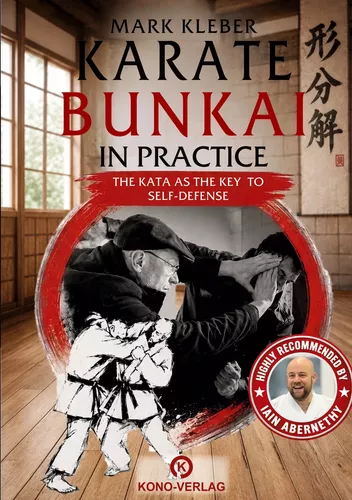
The roots of karate lie in practical self-defence. Its principles remain relevant today - and they are preserved within the movements of karate kata. Each kata can be seen as a collection of proven methods for unarmed self-defence). The key is learning how to read them.
In this book, Mark Kleber presents a systematic and practical approach to interpreting karate kata. His central message is simple: Bunkai does not have to be mysterious. Everyone can learn to analyse kata and discover meaningful applications within its movements.
A 5th Dan, licensed karate instructor and World Combat Association instructor, Mark combines historical background and fundamental principles with a structured methodology for practical training. His E.S.C.A.P.E. and W.E.A.P.O.N. models provide a framework for understanding kata from the perspective of realistic self-defence.
The book includes practical training exercises, illustrated bunkai examples and useful checklists for analysing kata independently. It is designed not only for advanced karateka and instructors, but for anyone with a basic understanding of kata and the curiosity to explore what lies beneath its surface - from yellow belt to Dan grade.
A major influence on Mark's approach is internationally renowned practical karate and bunkai expert Iain Abernethy, under whom Mark graded to 5th Dan in 2022. Abernethy's systematic approach to kata and practical self-protection played an important role in Mark's own development and in the ideas explored in this book. Iain Abernethy also personally reviewed and approved the English translation of this edition.
This book gives you the tools to find your own way through kata: to analyse movements independently, identify practical applications and develop training methods that work under realistic conditions.
By applying its concepts to your own practice, you can bring greater meaning to your kata, greater realism to your bunkai, and a deeper understanding of the self-defence principles that have always been at the heart of karate.
Mark started his journey in karate in 1990 while he was a university student. At the time, he had no idea that Karate-Do would become a lifelong path. In 1998, he earned his first Dan, followed by his first coaching qualification in 2000. As a black belt, his interest increasingly turned towards the world of kata. He was particularly inspired by seminars with self-defence expert Gilbert Gruss. Gruss's approach to teaching the practical applications of kata opened up new perspectives and further fuelled his curiosity.
In 1999, Mark spent several months training in Los Angeles with Grandmaster Hirakawa, founder of Tenshin-Kai Karate. Hirakawa's profound knowledge of tactics and body mechanics provided important inspiration that would continue to influence Mark's development in karate.
In 2015, Mark completed the KVBW courses to qualify as a self-defence instructor. The deeper he explored kata, the more questions arose: What principles underlie kata? How can these principles be effectively taught in training? And how can kata be connected with practical self-defence?
His search for answers eventually led him to Iain Abernethy. In 2016, Mark attended one of Iain's bunkai seminars for the first time and found what he had been looking for: a sophisticated and systematic training methodology for making the self-defence principles contained within kata applicable in a practical way.
A milestone was Mark's meeting with Nicolas Hofele at UKD (Uni Karate Dojo) Stuttgart. As a student of Iain Abernethy, Nicolas incorporates and further develops Abernethy's ideas in his goshin training. (Goshin is capitalized while words like kata are not. I am not expert enough to know why) Mark's fascination with this practical approach to karate continues to drive him to this day. At the same time, he seeks to build bridges between modern karate and its roots in kata.
In June 2022, Mark passed his examination for 5th Dan under Iain Abernethy. The preparation for the theoretical part of this examination ultimately provided the foundation for this book. He is an instructor with the World Combat Association (WCA). Mark Kleber studied Applied Theatre Studies in Giessen before completing a traineeship at the Southern Germany Broadcasting Corporation SDR, now SWR. He has worked as a journalist ever since and currently is head of a journalistic department.
He has published several radio plays and a children's book, and regularly conducts workshops on presentation and communication.








Es sind momentan noch keine Pressestimmen vorhanden.