
Skip to the end of the images gallery Navigation umschalten
Skip to the beginning of the images gallery Navigation umschalten
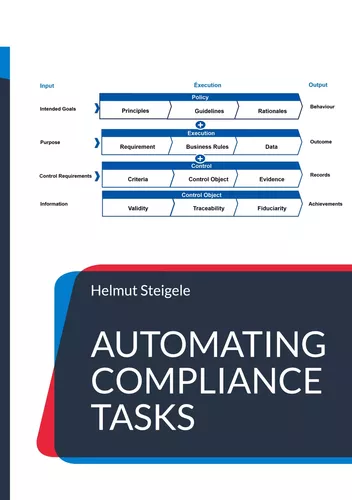
Automating Compliance Tasks
A Guide applied to the World of ISO Standards
ePUB
1,4 MB
DRM: Wasserzeichen
ISBN-13: 9783769382228
Verlag: BoD - Books on Demand
Erscheinungsdatum: 11.08.2025
Sprache: Deutsch
Barrierefreiheit: Eingeschränkt zugänglich
erhältlich als:
10,99 €
inkl. MwSt.
sofort verfügbar als Download
Du schreibst?
Erfüll dir deinen Traum, schreibe deine Geschichte und mach mit BoD ein Buch daraus!
Mehr InfosThis guide offers a practical framework for understanding, implementing, and automating compliance tasks in the context of ISO standards and modern management systems. The author, Dr. Helmut Steigele, argues that in a world shaped by unpredictability, increasing regulation, and digital transformation, trust is a key corporate asset, one that must be systematically built and proven.
Compliance is presented not merely as rule following but as a method of demonstrating diligence, foresight, and reliability to internal and external stakeholders. ISO standards (e.g., 9001, 27001, 14000, 20000) offer structured ways to systematise this trust via documented management systems.
The book emphasizes that effective management systems are not bureaucratic burdens but tools for structured, adaptive leadership. They support decision-making, align teams, and create transparency, especially when coupled with automation and digital technologies like document management systems, robotic process automation (RPA), and agentic AI.
A staged approach is recommended for implementation, starting with understanding purpose and scope, defining goals, assigning responsibilities, selecting resources, and operationalising processes. Emphasis is placed on involving stakeholders, managing resistance to change, and using behavioural models (like Kübler-Ross, Kotter, and Lewin) to guide successful transformation.
Ultimately, automating GRC (Governance, Risk & Compliance) tasks is not just about reducing manual effort. It is about institutionalising resilience, speeding up detection of risks, enabling early intervention, and preserving trust capital in volatile, uncertain environments
Compliance is presented not merely as rule following but as a method of demonstrating diligence, foresight, and reliability to internal and external stakeholders. ISO standards (e.g., 9001, 27001, 14000, 20000) offer structured ways to systematise this trust via documented management systems.
The book emphasizes that effective management systems are not bureaucratic burdens but tools for structured, adaptive leadership. They support decision-making, align teams, and create transparency, especially when coupled with automation and digital technologies like document management systems, robotic process automation (RPA), and agentic AI.
A staged approach is recommended for implementation, starting with understanding purpose and scope, defining goals, assigning responsibilities, selecting resources, and operationalising processes. Emphasis is placed on involving stakeholders, managing resistance to change, and using behavioural models (like Kübler-Ross, Kotter, and Lewin) to guide successful transformation.
Ultimately, automating GRC (Governance, Risk & Compliance) tasks is not just about reducing manual effort. It is about institutionalising resilience, speeding up detection of risks, enabling early intervention, and preserving trust capital in volatile, uncertain environments

Eigene Bewertung schreiben



Es sind momentan noch keine Pressestimmen vorhanden.