
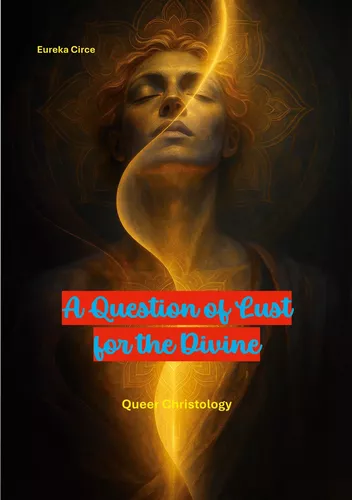
A Question of Lust for the Divine
Queer Christology
Eureka Circe (Hrsg.)Gesellschaft, Politik & Medien
ePUB
11,8 MB
DRM: kein Kopierschutz
ISBN-13: 9783695153374
Verlag: BoD - Books on Demand
Erscheinungsdatum: 30.12.2025
Sprache: Englisch
Barrierefreiheit: Eingeschränkt zugänglich
erhältlich als:
inkl. MwSt.
sofort verfügbar als Download
Du schreibst?
Erfüll dir deinen Traum, schreibe deine Geschichte und mach mit BoD ein Buch daraus!
Mehr InfosThe first part lays the foundations for a lust for the divine; the following parts show how the frame of 'creation order' shifts to creation diversity and what consequences this has for sacraments, language, pastoral care and canon law. The book invites an objective, clear and effective dialogue - with respect for tradition and clear words for a church that understands diversity as a gift and respects incarnation physically.
This volume, covering days 1-7, introduces the topic and methodology: it outlines how shared pleasure can be understood as a reflection of divine abundance. Key concepts of queer theory are bundled and highlighted for the leap to Christology: incarnation, corporeality and authority are profiled in dialogue with liberation theologies - right up to controversial touchstones such as 'Was Jesus gay?' and the question of sacramental marriage for all before the altar. Boundaries and blind spots explicitly invite dialogue. The question is also asked how an expanded image of God ('God is queer?') can reopen the discussion of the Trinity and gender as well as interreligious resonances. Ultimately, the question is how research agendas, pastoral innovations, curricula and digital spaces can be equipped with exercises that consciously rewrite texts and images.

Eureka Circe (Hrsg.)
Eureka Circe is the editor and curator of various book series on theology (such as 'House of Theological Courage' or 'Deus Ex Machina' and 'I, Circe') and on naturopathy. She has also published volumes on women's politics, including 'MAIDEN'S MANIFESTO - The Female Flame: Female Popes of Theology on the Holy Roman Chair', 'Alice and the Wonderyes - Where and Why Feminism Fails in the Catholic Church' and 'Dignitas Omnium - The Dignity of All'.
Her thesis: "Artificial intelligence (AI) represents a profound turning point because it fundamentally changes the relationship between humans, knowledge and access to the world - not only technically, but also culturally, epistemologically and socially. It opens up a new access to knowledge and leads to its multiplication and democratisation: AI systems make information readily available - often without the need for traditional reading or in-depth prior knowledge. This fundamentally changes how we think, learn and understand, while at the same time promoting a new form of individualisation of thought - which can also be exemplified in spiritual belief. What's more, machines now generate meaning - texts, images, arguments - where previously only human expertise was required. This has long-term consequences for education, science, politics and religion."



Es sind momentan noch keine Pressestimmen vorhanden.